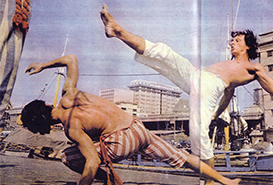
 The contemporânea style was primarily developed by Grupo Senzala in Rio de Janeiro during the 1960s. This style heavily influenced capoeira regional, and most of the groups called “regional” today are actually much closer to contemporânea than to Mestre Bimba’s original capoeira regional (which used a very particular and specific teaching method).
- Generally faster-paced, short games, averaging around one minute. Buying the game is common practice.
- Some contemporânea groups try to merge elements of angola and regional into a single style; others practice each one separately depending on what rhythm the bateria is playing.
- Emphasis on technique.
- A wide variety in the composition of the bateria – most groups use more than the simplified bateria of regional, but do not include all the instruments of angola. Some groups use ladainhas, chulas, and chamadas when playing to the angola toque; others do not.
- More standardized ginga.
- Some groups make use of floreios or flips during the game or to enter the roda.
- Use of batizados and colored cordas to classify the levels of the capoeiristas.
- Capoeira contemporânea is by far the most widespread style both inside and outside Brazil.